
Share this
by Muiris Lyons on 25/11/25

A New Era for ADR in Clinical Negligence?
The clinical negligence litigation landscape is changing rapidly, and alternative dispute resolution (ADR) is now central to how claims are managed and resolved.
The National Audit Office in its report on the Costs of Clinical Negligence published on 17 October 2025 confirmed that in 2024/25, NHS Resolution (NHSR) resolved 83% of clinical negligence cases without litigation (pre-issue). The figure was 66% in 2006/07.[1] One of the reasons for this significant improvement is the increased prevalence of mediation within clinical negligence.
NHSR explains that its mediation service supports patients, families, and NHS staff in working together towards resolution of incidents, complaints, legal claims, and costs disputes, avoiding unnecessary expense, time, stress, and potential emotional distress. The service provides access to an independent, accredited mediator, selected from a panel drawn from a wide range of backgrounds.
CEDR has been at the forefront of this development partnering with NHSR since the introduction of the mediation scheme in 2016. CEDR’s specialist clinical negligence panel brings together decades of experience, legal and medical expertise, and a commitment to achieving the best outcomes for all parties.
The New NHSR Contract and Early Neutral Evaluation
This year, NHS Resolution (NHSR) renewed its four-year contracts with a select panel of ADR providers, including CEDR, to deliver mediation services in clinical negligence and personal injury claims. The new contract does more than extend the current mediation scheme, it introduces Early Neutral Evaluation (ENE) as an additional tool to help parties resolve disputes earlier and more efficiently.
Mediation is now a well-established part of the clinical negligence process. Since NHSR adopted mediation in 2016, more than 2,000 claims have been referred[2], with consistently high settlement rates, 79% of mediations in 2023/24 resulted in resolution on the day or within 28 days.[3] The innovation in this new contract is the integration of ENE. Piloted successfully in 2023/24, ENE provides the parties with a confidential, non-binding and without prejudice opinion from an independent evaluator with specialist knowledge of the subject matter to give an assessment of the merits of their respective claims. For claimant and defendant lawyers alike, ENE can be a valuable reality check: clarifying the strengths and weaknesses of a case, narrowing the issues in dispute, and often paving the way to earlier settlement.
The NHSR mediation service has developed significantly since its inception:
- 2016 – Scheme launched as a pilot focused solely on clinical negligence claims.
- 2018 – Scheme made permanent and scope expanded to include personal injury claims against NHS organisations (such as employer’s liability and public liability cases).
- 2024 – New four-year contracts awarded to CEDR and other providers, confirming mediation as a core part of NHSR’s dispute resolution approach and adding Early Neutral Evaluation (ENE) as a further option.
This evolution reflects NHSR’s growing confidence in mediation and its willingness to broaden ADR opportunities for both clinical negligence and personal injury claims.
ENE in Practice: The Value of Experience
Neutrality has always been the cornerstone of mediation. Yet, as the practice of mediation continues to evolve, there is increasing debate about whether mediators should remain strictly facilitative or, at times, adopt a more evaluative approach. Many mediators now agree that there is a place for constructive honesty, provided it is offered at the right moment and in the right way.
In my own mediation experience, the evaluative element often arises as a natural extension of the process. When discussions stall or the parties reach an impasse, and where they have chosen a mediator precisely because of that mediator’s depth of expertise, it is not uncommon to be asked for a view. For those mediators who also hold judicial or part-time judicial appointments, the question is sometimes put directly: “How would you approach this issue if you were hearing it as a judge?”
This is where the value of experience comes to the fore. With more than 30 years in clinical negligence practice, including as head of one of the UK’s leading claimant firms and a former President of the Association of Personal Injury Lawyers, I have occasionally been asked to offer a neutral perspective grounded in lived expertise. Until now, that evaluative role has been ad hoc. Under the new NHSR scheme, however, Early Neutral Evaluation (ENE) is formally recognised as an official tool in the mediator’s toolbox. A deep understanding of the clinical negligence landscape, combined with formal ENE accreditation, enables us to provide parties with a structured, credible reality check that can unlock settlement, or at the very least narrow the issues for trial.
CEDR ran its first ENE accreditation course in October, and I was delighted to be among the first clinical negligence mediators to become formally accredited under the scheme. This combination of professional training and practical experience means parties will be able to access ENE through the NHSR process with clear parameters and the reassurance of a formally recognised framework.
Taken together, mediation and ENE offer a flexible ADR toolkit, one that can be tailored to the nature of the dispute and the stage of proceedings, helping parties find resolution earlier, more efficiently, and with greater confidence.
The Clinical Negligence Landscape: Key Statistics & Trends
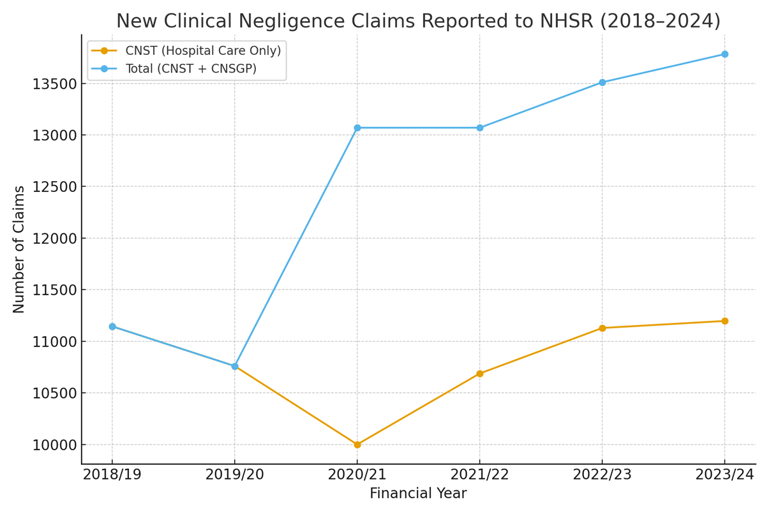
It's helpful to review the NHSR’s renewed commitment to mediation under the new 4-year scheme in the context of the data available from the latest NHSR Annual Report. This was published in July 2025 and shows a 4.7% increase in claims last year from 13,784 to 14,428[4] and claims for the last four years present a significant upward trend. However, most of this reflects the inclusion of GP and other claims previously dealt with by medical protection societies from 2020/21 onwards, rather than an underlying rise in claims against the NHS. If you strip out the impact of including GP claims, hospital (CNST) claims have remained relatively constant over the last four years post-Covid.
The Cost and Scale of Clinical Negligence
Based on the NHSR Report, the financial cost of clinical negligence continues to rise. In 2024/25 NHS Resolution paid out £3.088 billion in clinical negligence payments, up from £2.821bn the previous year (+6.8%).[5] Of this:
- £2.286bn represented damages (+6%),
- £620m was claimant legal costs (+11%), and
- £181m was NHS defence costs (+6%).
At the balance sheet level, NHSR’s provision for accumulated clinical negligence liabilities as at 31 March 2025 was £60bn, with high-value obstetric claims accounting for the majority of that exposure.[6]
There were only 24 clinical negligence claims which went to trial in 2024/25, and in those the claimant was successful in only 9 (37.5%).[7]
The 2024/25 Picture
According to analysis published by Legal Futures (29 September 2025)[8], the financial and market pressures in clinical negligence are continuing to grow. In particular, they point to the 5% increase in claims reported and the 3.5% increase in claims registered with the Compensation Recovery Unit (CRU). They highlight that the market is expanding: law firm revenues from clinical negligence work rose to £1.7bn (+8.1%),[9] while total NHS expenditure on claims hit £3.1bn.
When is Mediation Most Helpful?
Traditionally, mediation was often a settlement option prior to trial, alongside or instead of a Round Table Meeting (RTM) or Joint Settlement Meeting (JSM). However, with NHSR’s commitment to resolving more cases pre-issue to reduce costs, there is now a far more significant role for early, pre-issue mediations. These early interventions can help parties narrow the issues, clarify positions, and even if the case does not settle, set the stage for more efficient litigation. The growth in pre-issue mediations is a testament to the effectiveness of ADR in delivering better outcomes for all stakeholders.
Conclusion
The message from NHSR’s latest figures, the new contract, and wider market trends is clear: ADR is no longer an optional extra in clinical negligence. It is central to how claims are being managed and resolved. Mediation has already proven its worth, and the introduction of ENE offers an additional pathway to early, constructive resolution. For claimant and defendant lawyers alike, engaging with ADR is not just about saving costs, it’s about achieving better outcomes for clients, patients, and the NHS.
CEDR’s dedicated panel of clinical negligence specialists, including highly experienced former litigators now working as neutrals, is well placed to help parties navigate this new era of ADR.
If you would like to discuss a clinical negligence claim or explore how mediation or ENE could help resolve your dispute, please contact the CEDR clinical negligence panel.
Muiris Lyons is a CMC registered and CEDR-accredited mediator and is one of the first to achieve formal accreditation by CEDR for Early Neutral Evaluation (ENE). With more than 30 years’ experience as a leading clinical negligence litigator, including over 15 years as Head of Department at one of the UK’s top claimant firms and a former President of the Association of Personal Injury Lawyers, he brings unparalleled insight into the complexities of high-value and sensitive claims. Muiris is passionate about the use of ADR to achieve better outcomes for clients, practitioners, and the NHS alike.
Sources
[1] Para 17 NAO Report - Costs of Clinical Negligence 17.10.25
[2] CEDR figures
[3] The NHSR report states: "In 2024/25 a total of 138 claims proceeded to mediation with 73% of the claims settling on the mediation day or within 28 days of the mediation.”
[4] NHSR. Annual Report and Accounts 2024/25 17.07.25 p23
[5] Supra p43
[6] NAO Report p4
[7] NHSR Report p45
[8] Legal Futures (29 Sept 2025): ‘Strong growth predicted for clinical negligence market’ – summarising 2024/25 totals and CRU registrations.
[9] In its UK clinical negligence 2025 market trends report, IRN combined these figures (allowing for 20% to go towards after-the-event insurance premiums) with estimated success fees, payments from other sources like legal expenses insurance, and cases involving non-NHS providers.